On this page
- How many times will you transplant a cannabis seedling?
- What are the five signs your seedling is ready to up-pot?
- How big should the next pot be?
- How do you transplant cannabis seedlings without transplant shock?
- What transplant mistakes wreck seedlings?
- How do you spot and recover from cannabis transplant shock?
- What about autoflowers, coco, and outdoor transplants?
- What should you do next?
Most guides answer "when to transplant cannabis seedlings" with a calendar window: week two, week three, day twenty-one. The trouble is you don't have a stopwatch on the plant in front of you. You have a seedling in a solo cup, and you want to know if today is the day.
This guide flips the question. Instead of weeks, you look at the plant. Five signals tell you when to up-pot, no calendar required. If you haven't germinated yet, our how to start your first cannabis grow walkthrough covers the gear and seed phase.
How many times will you transplant a cannabis seedling?
Most home growers move a seedling two or three times before harvest. A typical soil path starts in a solo cup or jiffy pellet, steps up to a 1-gallon pot, then settles into a 3 or 5-gallon final pot (a fabric pot for the best root architecture). Coco growers often add an extra up-pot because coco dries faster and the root ball outgrows its container sooner.
The full arc takes 8 to 12 weeks before flower starts, depending on strain and conditions. For the wider picture, see our seed-to-harvest timeline.
The rule for each step: the next pot should hold 3 to 5 times the volume of the current one. Bigger jumps look efficient but tend to backfire. More on that below.
What are the five signs your seedling is ready to up-pot?
Run through this list. If you see three or more, the plant is ready.
Roots visible at the perimeter of the cup or at the drainage holes. Lift the solo cup and look at the sides if it's translucent, or tip the plant and check the bottom. White roots circling the edge or poking through drainage holes mean the root ball has run out of room.
Drink rate has doubled in a week. A seedling that needed water every three or four days now wants it every day or every other day. That's a much bigger plant pulling moisture out of a small volume of media.
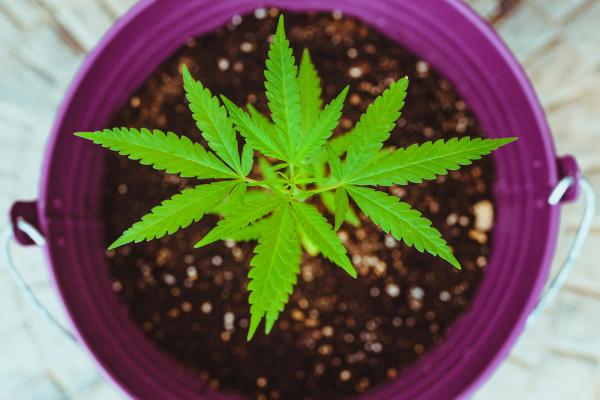
Three to four sets of true fan leaves above the cotyledons. The first round leaves are the cotyledons. Above those, count the serrated fan-leaf sets. By the time you have three or four stacked up, the canopy has outgrown what the root zone can support.
Top growth has slowed even though everything else looks fine. When new growth pauses without yellowing, spots, or any environment change, the most common reason is that the roots have filled the container.
The cup feels surprisingly light a day after watering. Pick it up just before you'd normally water. If a freshly-watered cup feels close to dry within 24 hours, the root mass has displaced most of the media.
You don't need all five. White roots at the perimeter plus a doubled drink rate is enough on its own.
What does a root-bound cannabis seedling look like?
A root-bound seedling shows tight white roots wrapping the inside of the container in circles. If you slide the plant out and the root ball holds the exact shape of the cup with very little visible soil between the roots, you waited a bit too long. The plant will recover, but expect yellowing lower leaves and a few stalled days while it stretches into fresh media.
How big should the next pot be?
Stick with the 3 to 5x volume rule. A 16-ounce solo cup is roughly half a quart, so a 1-gallon pot is the right next step. From a 1-gallon, move to a 3 or 5-gallon final pot.
A common beginner instinct is to jump straight from a solo cup to a 5-gallon to save a step. It usually does the opposite of what you want. A small root system in a large pot can't drink the water that volume of soil holds, so the media stays wet for days. Wet, cool media invites damping off, root rot, and fungus gnats. The plant sits there looking sad while the soil dries out, and you lose more time than the proper up-pot would have cost.
Fabric pots are great from the 1-gallon stage on. They air-prune the roots, which produces a denser, branchier root ball instead of a single circling mass. For the solo cup stage, plastic is fine because the seedling won't be there long enough for pot shape to matter.
How do you transplant cannabis seedlings without transplant shock?
A clean transplant takes about ten minutes. The plant should barely register it happened.
Water the seedling 2 to 3 hours before. Damp media holds together; dry media falls apart and tears roots when you slide it out.
Fill the new pot with moist media (the feel of a wrung-out sponge for soil). For coco, pre-buffer with cal-mag-treated water before potting.
Dig a hole in the new media about the size of the solo cup.
Invert the cup and support the stem between two fingers as the root ball slides out. Don't pull on the stem. If it sticks, squeeze the sides of the cup or cut the cup away with scissors.
Place the root ball so the old soil line matches the new soil line. Buried stems can rot if the new media stays too wet.
Backfill with moist media. Press lightly, don't pack hard.
Water in with about a cup of plain water (or very light nutrient solution in coco) at the base of the stem. This settles media against the roots.
Hold the environment steady for 48 to 72 hours. No light-schedule changes, no training, no nutrient pushes. The plant is rebuilding contact with the new media and doesn't need other variables in play.
If you did it right, the plant looks the same the next morning and starts growing visibly within three or four days.
What transplant mistakes wreck seedlings?
A handful of mistakes account for almost every failed up-pot. Most come from doing too much, too fast.
- Transplanting on a calendar instead of on signals. "It's been two weeks, so I'm up-potting" is how plants that weren't ready end up sitting in cold, wet soil.
- Jumping more than 5x in volume. Solo cup straight to 5-gallon is the classic version. The plant gets waterlogged and stunts.
- Full-strength feed right after the up-pot. New roots are sensitive. Save the strong feed for the second watering at the earliest. If you're in coco, our feeding seedlings in coco guide covers the EC ramp.
- Topping or training within a week of the transplant. The plant is already absorbing one stress. A second invites a stall.
- Dry media in the new pot. Roots avoid dry pockets and grow around them instead of through them.
- Overwatering after the transplant. This is the single most common wrecker, especially in coco. Light water-in only, then back off until the pot feels light again. See our walkthrough on how to spot and fix overwatering in coco if you suspect you've gone too far.
For the wider list of beginner pitfalls beyond transplanting, see our roundup of 13 mistakes that ruin a first cannabis grow.
How do you spot and recover from cannabis transplant shock?
Transplant shock looks like the plant has given up. Leaves droop, top growth pauses for two or three days, and sometimes lower leaves go a bit pale. The key signal is that this passes on its own within 72 hours if the underlying transplant was clean.
What it isn't:
- Yellowing that gets worse over a week. That's usually a deficiency. Use our cannabis nutrient deficiency identifier to narrow it down.
- Permanent droop with wet, heavy soil. That's overwatering, not shock.
- Crispy leaf tips a day or two after transplant. That's nutrient burn.
If you suspect real shock, the cure is patience. Hold the environment stable, skip nutrients, skip training, and dim the light by 20 percent if you have a dimmer. Most seedlings recover by day three or four.
What about autoflowers, coco, and outdoor transplants?
Autoflowers run on a fixed clock from seed, and any stress can clip the final yield. A lot of autoflower growers skip the up-pot entirely and start the seed directly in the 3 or 5-gallon final pot. The downside is wet, cool media for the first two weeks while the small root system catches up. The upside is zero transplant stress. Both work. If you do up-pot an autoflower, get it done before pre-flower, usually before week three.
Coco timing differs from soil. Because coco gets watered to runoff every day or two, a seedling can outgrow a solo cup in 10 to 14 days. Watch the signals, not the calendar.
Outdoor transplanting adds one extra step: hardening off. Give an indoor-raised seedling a week of progressively longer outdoor exposure: an hour in shade on day one, two hours on day two, and so on. Skip this and indoor-raised plants end up sunburned and wilted by the end of their first afternoon outside.
What should you do next?
Three things, in order.
First, look at your plant tonight. Run the five-signal checklist. If you see three or more, plan to transplant tomorrow afternoon (water the cup this evening so the root ball is ready).
Second, log what you see. Snap a photo of the root ball when you slide the plant out, note how many days the seedling sat in the cup, and write down the pot sizes you used. Six weeks from now, when you're tuning your next grow, this record is the most useful thing you'll own.
Third, help us shape what comes next. We're running a quick poll on what to build for home growers, and a transplant logger keeps coming up in early answers. Drop your vote and stay close to the community while we figure out the next round. The more growers weigh in, the better we can build for the way you actually grow.
Frequently asked questions
When should I transplant cannabis seedlings? When you see three or more of the five signals listed above. Most growers hit that window 14 to 21 days after the seed cracks, but the plant decides, not the calendar.
Can you transplant cannabis seedlings too early? Yes. If the root ball hasn't filled the cup, it falls apart when you slide it out, and the small root system sits in too much wet media. Wait for white roots at the perimeter.
Do you water before or after transplanting? Both, but mostly before. Water 2 to 3 hours ahead so the root ball holds together, then give a small water-in once the plant is settled.
Should you transplant autoflowers? You can, but most growers don't. Plant the seed directly in the final pot. If you do up-pot an autoflower, get it done before pre-flower.
How do I avoid transplant shock? Damp media in the new pot, no nutrient pushes for a few days, no training for a week, and a stable environment.